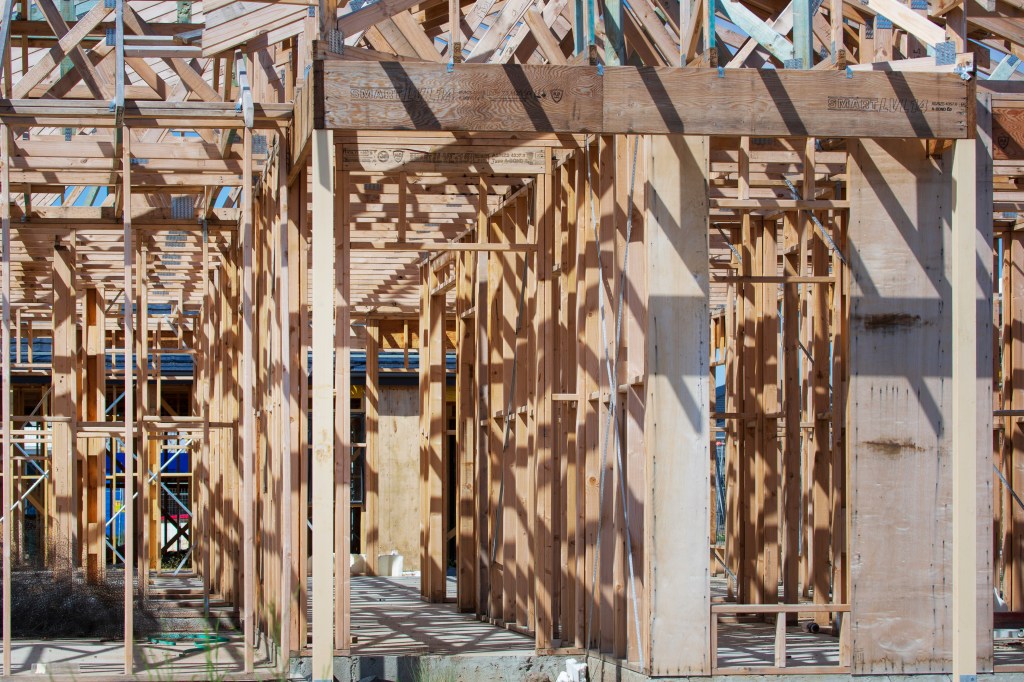
Timber construction in the UK has evolved from medieval craft-based methods into highly sophisticated Modern Methods of Construction (MMC) involving standardised, prefabricated components. Today, timber is a critical structural material used for a wide range of buildings, from single-family homes to medium-rise multi-storey structures up to seven storeys high.
Predominant Structural Systems
The UK industry primarily utilizes several distinct systems:
• Platform Timber Frame: This is the most commonly used method in the UK. It uses storey-height timber wall panels that act as vertical loadbearing diaphragms, providing a “platform” for the floor of the next storey.
• Post and Beam: These systems, often using Glued Laminated Timber (Glulam) or Laminated Veneer Lumber (LVL), are popular for industrial, commercial, and architectural buildings where the structure is often left visible.
• Engineered Wood Products (EWPs): Modern construction increasingly relies on EWPs such as Cross Laminated Timber (CLT), I-joists, and Laminated Strand Lumber (LSL) to overcome the size and quality limitations of solid sawn timber.
• Volumetric/Modular: This involves the complete off-site prefabrication of room-sized “box units” that are delivered and assembled on-site.
Roofing and Flooring Standards
Roofs and floors are central to the structural integrity and inhabitant comfort of UK timber buildings:
• Trussed Rafters: Since their introduction in the 1960s, trussed rafters now account for over 90% of all house roof construction in the UK. They are factory-prefabricated using punched metal plate fasteners and are designed to carry vertical loads while relying on site-fixed bracing for lateral stability.
• Floor Systems: UK floors typically comprise solid timber joists or engineered products like I-joists or metal web joists. These systems must resist vertical loads, act as horizontal diaphragms for wind loads, and meet strict criteria for vibration and acoustic performance.
Regulatory and Design Framework
UK timber design has undergone a significant shift in recent years:
• Design Codes: The industry has moved from the permissible stress design of BS 5268 to the limit state design philosophy of Eurocode 5 (BS EN 1995-1-1).
• National Annexes: Specific UK National Annexes define parameters for UK-specific environmental conditions, such as wind and snow loads.
• Quality and Safety: The National House-Building Council (NHBC) sets minimum quality standards for the majority of UK house builders, focusing on finish and durability beyond basic health and safety regulations.
Performance Challenges
UK timber construction must address three primary performance areas:
• Fire Resistance: Achieved through the natural charring of large timber sections (which protects the inner core) or by using protective sheathing/cladding (like gypsum plasterboard) for light-weight frames.
• Acoustics: Because timber is a lightweight material, careful detailing is required to limit airborne and structure-borne noise, often involving resilient layers or separate floor-ceiling sub-systems.
• Moisture and Durability: Timber must be maintained at a moisture content below 20% to avoid fungal decay. Designers often specify preservative treatments for softwoods in “at-risk” areas, such as external walls or ground floors
How do Modern Methods of Construction speed up timber builds?
Modern Methods of Construction (MMC) speed up timber builds primarily through the use of standardised, prefabricated components and the reduction of on-site labor requirements,.
Offsite Fabrication and Rapid Erection
The use of factory-assembled wall panels and floor “cassettes” allows for a significantly compressed erection timetable. It is common for a semi-detached house to be completed from the foundation slab to a weathertight stage in only 4 to 5 days. This efficiency is supported by staged deliveries where, for example, ground floor wall panels are erected on day one and floor cassettes are installed on day two. Engineered timber joists alone can offer a 66% reduction in floor installation time, as they are delivered to precise lengths and require no on-site cutting or notching,.
Simultaneous Build Processes
MMC allows different construction phases to be undertaken simultaneously rather than sequentially. Because the timber frame reaches a weathertight stage quickly, internal trades such as wiring, plumbing, and wall lining can begin much earlier in the programme,. Furthermore, external brickwork is removed from the critical path, meaning internal work can proceed even if the exterior envelope is not yet complete,.
Predictability and Reduced Risk of Delay
Modern timber construction offers a predictable timetable, which assists in meeting strict construction schedules. Speed is enhanced by the following factors:
• Reduced Site Storage and Waste: Offsite methods require less space for materials, making site planning easier,.
• Weather Independence: Fabrication occurs in controlled factory environments, making the build less susceptible to delays caused by poor weather,.
• Precision and Accuracy: The timber frame acts as a template with predetermined openings, ensuring dimensional accuracy so that windows and doors fit easily.
Performance Gains in Roofing and Specialized Elements
The introduction of trussed rafters now accounts for over 90% of UK house roofs because they can be built in a fraction of the time required for traditional roofs,. For more complex projects, such as attic construction or roof replacements, using prefabricated cassettes can reduce the installation of a new roof structure to a 2-day operation.
Overall Productivity Increases
Case studies indicate that timber frame developments can be completed 10 to 12 weeks ahead of traditional build schedules. In high-density housing projects, the adoption of timber frame MMC has been shown to increase annual unit completions by as much as 40% without a corresponding increase in direct labor costs. Given the current housing shortage, timber construction could be a solution to fast-track the house building industry in the UK to meet demand.
 HM Structures
Leave a comment