In recent years, you may have seen headlines about buildings being closed due to something called RAAC. Naturally, this has caused concern for homeowners and property buyers across the UK.
But what exactly is RAAC — and is it something you need to worry about in your own home?
As a structural engineer, this guide explains what RAAC is, where it’s typically found, and when it’s important to take action.
Reinforced Autoclaved Aerated Concrete (RAAC) is an engineered, lightweight cellular building material that was widely used in the UK for precast floor, roof, and wall panels between the 1950s and mid-1990s. Often referred to as “aircrete,” it is produced by a chemical reaction (typically involving aluminium powder) that creates hydrogen gas bubbles, resulting in a foamed structure with no coarse aggregate. Because the base material has a low tensile strength, these panels rely on embedded steel reinforcement for structural capacity.
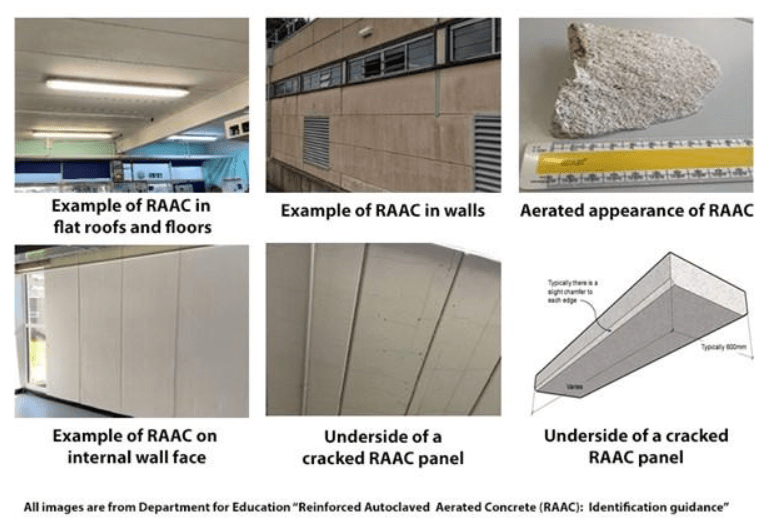
RAAC is most commonly found in:
- Schools
- Hospitals
- Public buildings
- Offices
It is less common in traditional houses, but may still be present in:
- Flat roof extensions
- System-built homes
- Post-war housing
- Some apartment blocks
RAAC panels are often hidden above ceilings or roof coverings, making them difficult to identify without investigation.
Why RAAC is a Problem in the UK?
RAAC presents significant structural challenges due to its unique material properties and the way it was historically designed and installed in UK buildings:
- Vulnerability to Corrosion: Unlike traditional dense concrete, the aerated nature of AAC does not provide a naturally alkaline environment to protect steel from rusting. Reinforcement was typically coated with bitumen or latex for protection, but these coatings frequently break down in panels over 20 years old, especially if the material becomes damp.
- High Permeability: The material is highly porous, meaning moisture can easily reach the reinforcement, accelerating corrosion and weakening the structural integrity.
- Poor Bond Strength: There is little to no inherent bond between the smooth reinforcement and the aerated concrete matrix. Structural integrity relies almost entirely on transverse “anchorage” bars welded to the main steel; if these are corroded or were poorly placed during manufacture, the panel is at risk of sudden failure.
- Excessive Deflection and Creep: RAAC is much more flexible than dense concrete and prone to significant long-term sagging (creep) under its own weight. In the UK, many panels designed before 1980 had span-to-depth ratios that were inadequate, leading to deflections that can exceed 1/100th of the span.
- Water Ponding: On flat roofs, excessive sagging can reverse drainage falls, causing rainwater to pond. This increases the weight on the panel and creates a “vicious cycle” where more water leads to more deflection and eventual penetration, triggering reinforcement corrosion
🚨 When Should Homeowners Be Worried?
For most homeowners, RAAC is unlikely to be present — but you should investigate further if:
- Your property was built between 1950 and 1990
- It has a flat roof of unknown construction
- It is a non-traditional or prefab home
- You live in a block of flats from that era
Signs That May Need Checking:
- Sagging ceilings
- Cracks along ceiling lines
- Water leaks or damp patches
- Visible deflection in roof panels
⚠️ These signs don’t confirm RAAC — but they do justify further inspection.
🔍 What Does RAAC Look Like?
RAAC has some distinctive features:
- Light grey or white colour
- Smooth underside
- Bubbly internal texture (like an Aero chocolate bar)
- No visible large aggregates (stones)
- Often installed in panels around 600mm wide
However, visual inspection alone is not enough — professional confirmation is required.
🛠️ What Happens If RAAC Is Found?
If RAAC is identified, the next step is assessment — not panic.
A structural engineer will determine:
- Condition of the panels
- Level of risk
- Whether immediate action is required
Possible Solutions:
✔ Monitoring and regular inspections
✔ Temporary propping
✔ Strengthening works
✔ Waterproofing
✔ Partial or full replacement
🏠 Is RAAC a Risk in Typical Homes?
For most traditional UK homes:
RAAC is unlikely to be present.
It is mainly found in:
- Public sector buildings
- Large-span flat roofs
- Post-war system-built structures
That said, if you are buying or renovating a property from this era, it’s always sensible to check.
🧠 Final Thoughts
RAAC is a serious issue in certain buildings, but for most homeowners, it is not something to panic about.
The key is awareness:
✔ Know when your property was built
✔ Understand the type of construction
✔ Investigate if there are warning signs
✔ Seek professional advice if unsure
With the right assessment, risks can be properly managed.
 HM Structures
Leave a comment