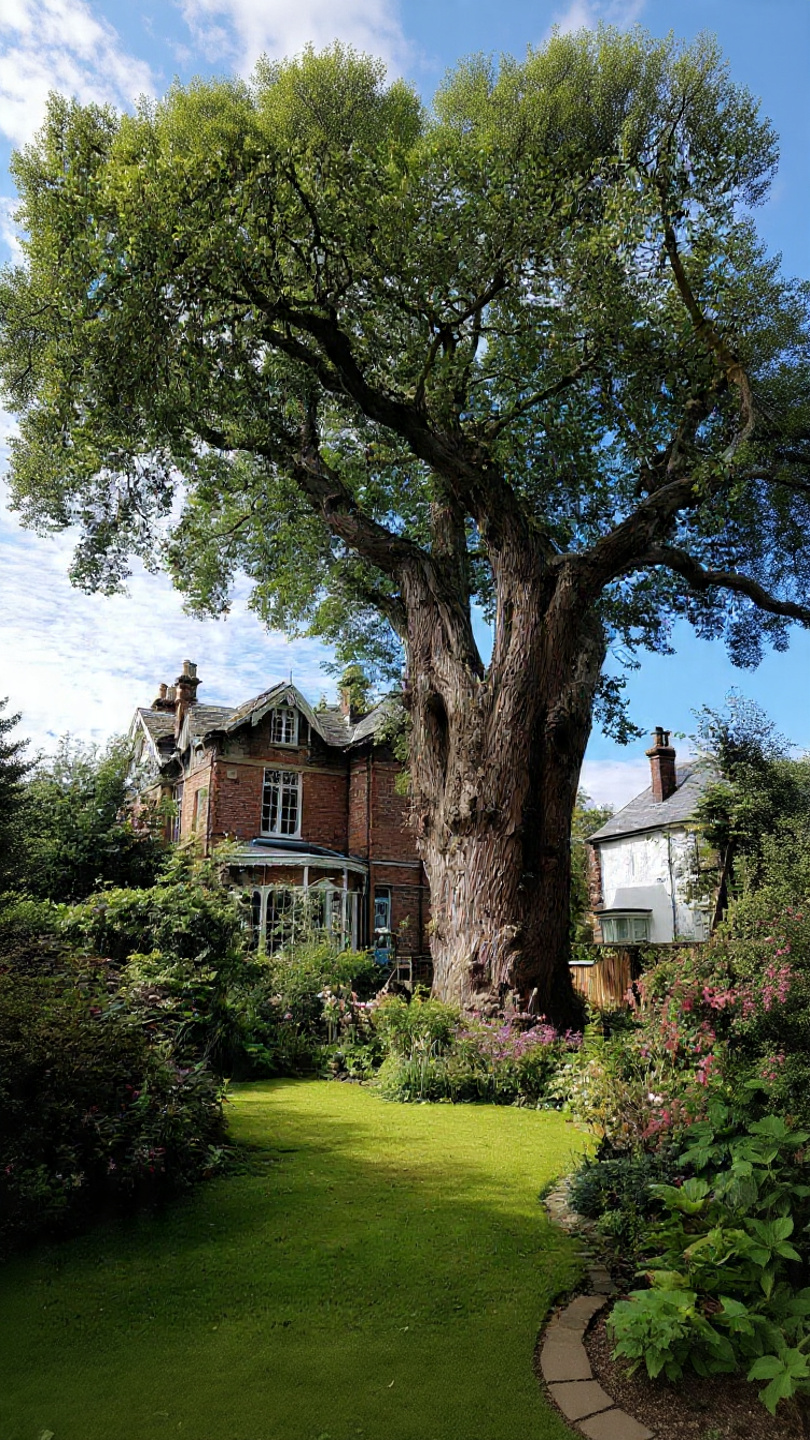
Trees can damage a property through indirect structural movement (subsidence and heave), direct physical pressure from growth, and maintenance issues related to drainage and roofing.
Trees can impact properties in the following ways:
1. Indirect Structural Movement (Clay Soils)
The most significant cause of damage is the interaction between tree roots and shrinkable clay soils, which accounts for approximately 70% of all subsidence claims in the UK.
• Subsidence (Soil Shrinkage): Trees transpire moisture through their leaves, which is sucked from the soil by fine roots. This “desiccation” causes shrinkable clay to reduce in volume, leading to downward foundation movement. While grass only affects the top 1.5m of soil, large trees can extract moisture from depths of 6m or more.
• Heave (Soil Swelling): When a tree is removed, the desiccated soil rehydrates and swells as moisture returns. This upward movement, known as heave, is often more damaging than shrinkage because it is progressive and can continue for decades; one case recorded measurable heave 25 years after tree removal.
• Surge Years: Damage is most prevalent during “surge years” characterized by exceptionally hot, dry summers when tree moisture demand is at its peak.
2. Direct Physical Damage
Trees can cause damage through the mechanical force of their physical growth:
• Mechanical Pressure: The physical expansion of a tree trunk or structural roots can exert lateral or upward pressure on a building. This is most common within 1.2m of the structure.
• Lightweight Structures: Because the weight of a house is substantial, direct root pressure rarely moves a main building; however, it frequently distorts garden walls, driveways, and pavings. Paving may dip toward trees, and asphalt often develops crescent-shaped cracks around them.
3. Damage to Drains and Services
Trees and drainage systems interact in several ways:
• Root Ingress: Roots do not typically “attack” sound pipes, but they are attracted to the moisture escaping from pre-existing defects or leaking joints. Once inside, roots proliferate, leading to major blockages.
• Foundation Interaction: If a leaking drain softens the surrounding clay, it can encourage localized root growth near foundations, exacerbating subsidence.
4. Maintenance and Ancillary Damage
• Gutter and Roof Blockage: Leaf litter and detritus from nearby trees can block gutters and downpipes, leading to water ponding, dampness, and rot in roof timbers.
• Acidic Runoff: Rainwater runoff from certain timbers, such as cedar shingles or organic growths like moss, is acidic and can attack unprotected metal gutters and flashings.
• Rain Shadow Effect: Overhanging dense vegetation can create a “rain shadow,” preventing rainfall from reaching the ground and causing excessive soil drying near shallow foundations.
• Slope Instability: While roots can help bind soil, the extra weight of large trees on certain parts of a slope can reduce stability and contribute to landslips.
Tree Species and Risk
The level of risk depends heavily on the species and its distance from the building. Oak, poplar, willow, and elm are identified as high-water-demand species most notorious for causing damage. As a general rule of thumb, damage can often be avoided if a tree is no closer to the foundations than its mature height.
How do tree species vary in their water demand?
Tree species vary significantly in their water demand—the amount of moisture they extract from the soil through transpiration—which is a critical factor in determining the risk they pose to foundations on shrinkable clay soils. Generally, broadleaf trees have a greater moisture demand than evergreens,.
Based on the sources, tree species are typically categorized by their level of water uptake and the depth to which they can desiccate (dry out) the ground:
High-Water-Demand Species
These species are identified as the most “notorious” for causing subsidence because they can extract large volumes of water from great depths,.
• Examples: Oak, poplar, willow, elm, and cypress are primary examples of high-demand trees.
• Depth of Influence: A large oak tree can desiccate soil to depths of 6 meters or more.
• Separation Rule: To avoid foundation movement, these trees are often recommended to be kept at a minimum distance of 1.0 times their mature height from a building.
Moderate and Low-Water-Demand Species
These species extract less water and are generally considered a lower threat, though they can still cause damage if planted very close to a structure.
• Moderate Demand Examples: Plane, lime, ash, beech, and birch are identified as having lower moisture demands than the high-demand group,. These are often recommended to be kept at a minimum distance of 0.5 times their mature height from foundations.
• Low Demand Examples: Small fruit trees like apple and pear have lower demands and are generally considered a threat only within a distance of 5 to 6 meters.
Physiological Factors Affecting Demand
The water demand of an individual tree is not determined by its height alone, but by several physiological factors described in the sources:
• Total Leaf Surface Area: The moisture demand is ultimately dictated by the tree’s crown volume and leaf area rather than its height. A larger crown means more leaves are transpiring water.
• Vigour and Growth Phase: Trees in a juvenile phase of rapid growth typically have a higher demand for water than mature or senescent trees.
• Stomatal Control: Some species have a greater ability to regulate water loss by closing their stomata (pores in the leaves) during peak midday temperatures, even if water is available in the soil,.
• Rooting Patterns: Water demand is also influenced by root morphology; for example, poplars have roots that run mainly horizontally, allowing them to extract moisture from a wide radius.
In high-plasticity clays, the high moisture demand of large trees during the summer may exceed the amount of rainfall available to replenish the soil in the winter, leading to a zone of permanently desiccated soil that can cause progressive structural damage.
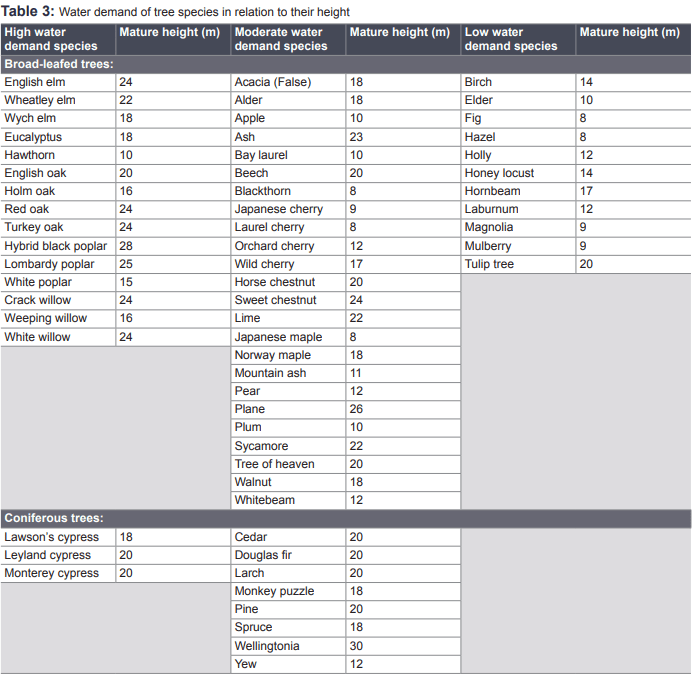
(Table from NHBC – Building near trees)
How does tree growth phase influence foundation moisture demand?
Tree growth phases—categorized as juvenile, mature, and senescence—significantly influence moisture demand and the resulting stability of foundations on shrinkable clay soils. As a tree progresses through these stages, the volume of soil affected and the intensity of moisture extraction vary, dictating whether foundation movement is progressive, seasonal, or reversing.
1. Juvenile Phase (Rapid Growth)
During the juvenile phase, trees experience relatively rapid growth, which creates a high and increasing demand for moisture,.
• Persistent Deficit Development: This is the phase when a “persistent moisture deficit” typically develops. This occurs because the tree extracts moisture faster than winter rainfall can replenish it, leading to a zone of soil that stays dry year-round,.
• Expanding Desiccation Zone: As the tree grows, the zone of permanently desiccated soil increases in both depth and lateral extent. Roots extend both laterally and downward, affecting an increasingly large volume of soil under a wider radius from the trunk.
• Progressive Movement: Because the moisture demand is increasing as the tree expands, buildings on shallow foundations near immature trees are at risk of progressive foundation movement, which can lead to increasingly severe structural damage.
2. Mature Phase
In the mature phase, the tree’s rate of growth slows down, and its crown and root system reach a state of balance.
• Stabilized Demand: Moisture demand remains high but becomes more stable compared to the rapid increase seen in the juvenile phase.
• Seasonal Cycles: While the persistent deficit is maintained, the primary concern shifts to seasonal shrinkage and swelling. The soil dries and shrinks in the summer and rehydrates in the winter, but generally returns to the same deficit level each spring.
• Drought Vulnerability: Significant new downward movement for a mature tree usually only occurs during exceptional spells of dry weather (droughts) where the seasonal moisture extraction exceeds normal levels.
3. Senescence and Overmaturity
The final phase of a tree’s lifespan, senescence, involves a slow decline characterized by reduced growth in some parts and dieback in others.
• Declining Uptake: As a tree becomes overmature, its water uptake naturally declines.
• Soil Recovery and Heave: A reduction in moisture demand means that winter rehydration begins to exceed summer extraction. This allows the persistent moisture deficit to slowly dissipate, leading to soil swelling and foundation heave.
• Long-term Effects: This recovery process is essentially the same as what occurs when a tree is felled, where the soil progressively returns to its original volume, potentially lifting the building over many years.
In summary, the risk of progressive subsidence is highest during the juvenile phase of rapid growth, while the risk of heave increases as a tree reaches overmaturity or is removed
 HM Structures
Leave a comment