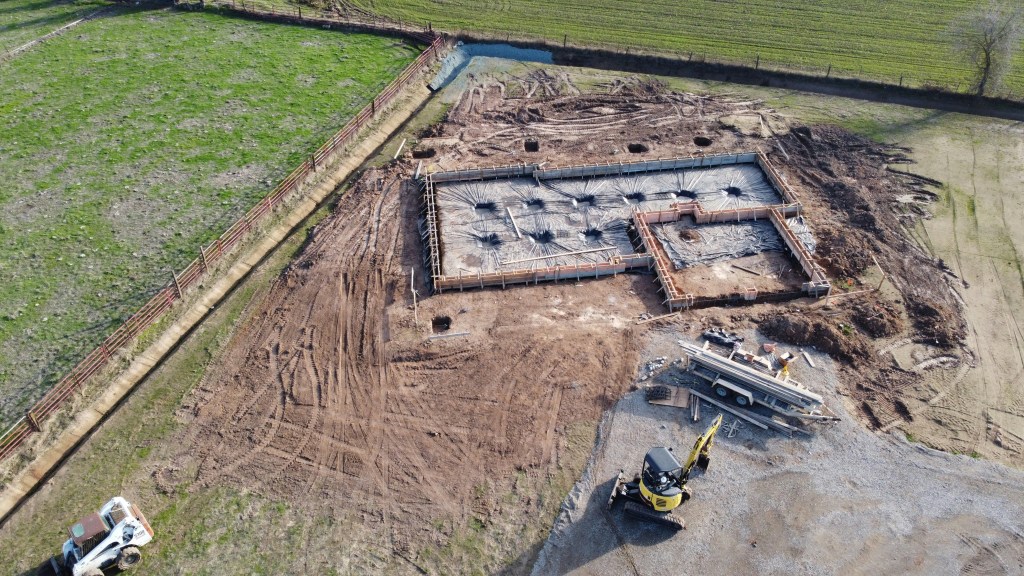
When we think about a house, we often focus on what we can see — the walls, roof, and rooms inside. But one of the most important parts of any home is something you rarely see at all: the foundations.
Foundations support the entire building, transfer its weight safely into the ground, and help prevent movement, cracking, and structural damage. In the UK, foundation design varies depending on soil type, ground conditions, and the age of the property.
This guide explains the most common foundation systems used in UK residential buildings.
🧱 What Do Foundations Do?
In simple terms, foundations:
- Support the weight of the building
- Spread loads evenly into the ground
- Prevent excessive settlement or downward movement
- Protect the structure from ground volume changes such as shrinkage or swelling
Choosing the right foundation type is essential for long-term stability and durability.
🌍 Factors That Influence Foundation Choice in the UK
Several factors determine which foundation system is used:
- Soil type (clay, sand, gravel, chalk, made ground)
- Presence of trees (especially on clay soils)
- Groundwater levels
- Load of the building
- Age of the property
- Local Building Regulations requirements
A structural engineer or geotechnical engineer will assess these factors before recommending a foundation type.
🏗️ Common Types of Foundations in UK Homes
1️⃣ Strip Foundations
Strip foundations are the most common type used in traditional UK housing.
🔹 What are they?
A continuous strip of concrete laid beneath load-bearing walls.
🔹 Where are they used?
- Traditional houses
- Low-rise residential buildings
- Stable ground conditions
🔹 Typical depth:
Usually between 600mm and 1,000mm, depending on soil and frost depth.
✅ Simple and cost-effective
❌ Not suitable for poor or highly variable groun
❌ Requires laying brickwork/blockwork within an excavated area which is more difficult and time consuming
2️⃣ Trench Fill Foundations
Trench fill foundations are a modern alternative to strip foundations.
🔹 What are they?
Deep trenches filled almost entirely with concrete, with brickwork/blockwork starting close to ground level.
🔹 Why are they popular?
- Faster to construct
- Less risk from ground movement
- Reduced labour time on site
🔹 Typical depth:
Often 1,000mm or more, depending on soil conditions.
✅ Faster and simpler to build
✅ Common in new-build housing
3️⃣ Pad Foundations
Pad foundations are used where loads are concentrated at specific points.
🔹 What are they?
Square or rectangular concrete pads that support columns or piers.
🔹 Where are they used?
- Porches
- Structural posts
- Beam-and-column structures
- Some extensions
❗ Less common for entire houses, but often used in combination with other systems.
4️⃣ Raft Foundations
Raft foundations are designed to spread the load over a large area.
🔹 What are they?
A thick reinforced concrete slab covering most or all of the building footprint.
🔹 When are they used?
- Poor or variable ground
- Areas with low bearing capacity
- Sites with a high risk of differential settlement
✅ Reduces uneven settlement
❌ Higher material and labour cost
❌ Requires careful engineering design
5️⃣ Piled Foundations
Piled foundations are used when the ground near the surface is not strong enough to support the building.
🔹 What are they?
Long vertical columns (piles) driven or bored deep into the ground to reach stronger soil or rock.
🔹 Common pile types in residential buildings:
- Mini piles
- Bored piles
- Driven piles
🔹 Where are they used?
- Poor ground conditions
- Near existing buildings
- Basement construction
- Underpinning projects
❗ Typically more expensive, but sometimes the only safe solution.
6️⃣ Underpinning (Remedial Foundations)
Underpinning is used for existing homes rather than new builds.
🔹 Why is it needed?
- Subsidence
- Foundation failure
- Change of use or increased loads
🔹 Common methods:
- Mass concrete underpinning
- Beam and base systems
- Mini piles
Underpinning should be designed and overseen by a structural engineer.
🧠 How Does a Structural Engineer Help?
A structural engineer plays a key role by:
✔ Assessing ground conditions
✔ Interpreting site investigation reports
✔ Designing suitable foundations
✔ Ensuring compliance with Building Regulations
✔ Preventing overdesign (saving money)
✔ Minimising future movement risks
For extensions, loft conversions, or subsidence-related work, professional input is essential.
 HM Structures
Leave a comment